
Introduction
The reason why Sir Don McCullin documented the ancient city of Palmyra with Historian Dan Cruickshank at the age of 82. The BBC made this into a documentary called ‘The road to Palmyra” available at www.dailymotion.com 2018. The programme shows the barbaric cultural destruction caused by the so-called Islamic State (IS) during the occupation in Syria circa 2011 during the Assad uprising.
Don McCullin is a world-renown war photographer documenting wars, conflict, famine across a myriad of troubled hotspots across the globe. During 2006-9 don McCollum travelled to the southern frontiers to capture stunning landscape images of ancient ruins in the particular ancient city of Palmyra in Syria. Landscapes within his portfolio showcase a different emotional side than his sharp and truth-telling war images.
McCullin travelled back to the see the city of Palmyra to photograph the landscapes he had previously taken back in 2006-9. McCullin uses the available light and sky to create his gritty black-and-white pictures using a medium format camera with a yellow filter to add another level of contrast from something he had learned from the early work of Alfred Stieglitz.
The image he captured back in 2017 shows the ancient Roman theatre in Palmyra. It has stood for thousands of years throughout history untouched and preserved. Thousands of people have travelled to visit and see what has been called the “Venice in the Sands.”
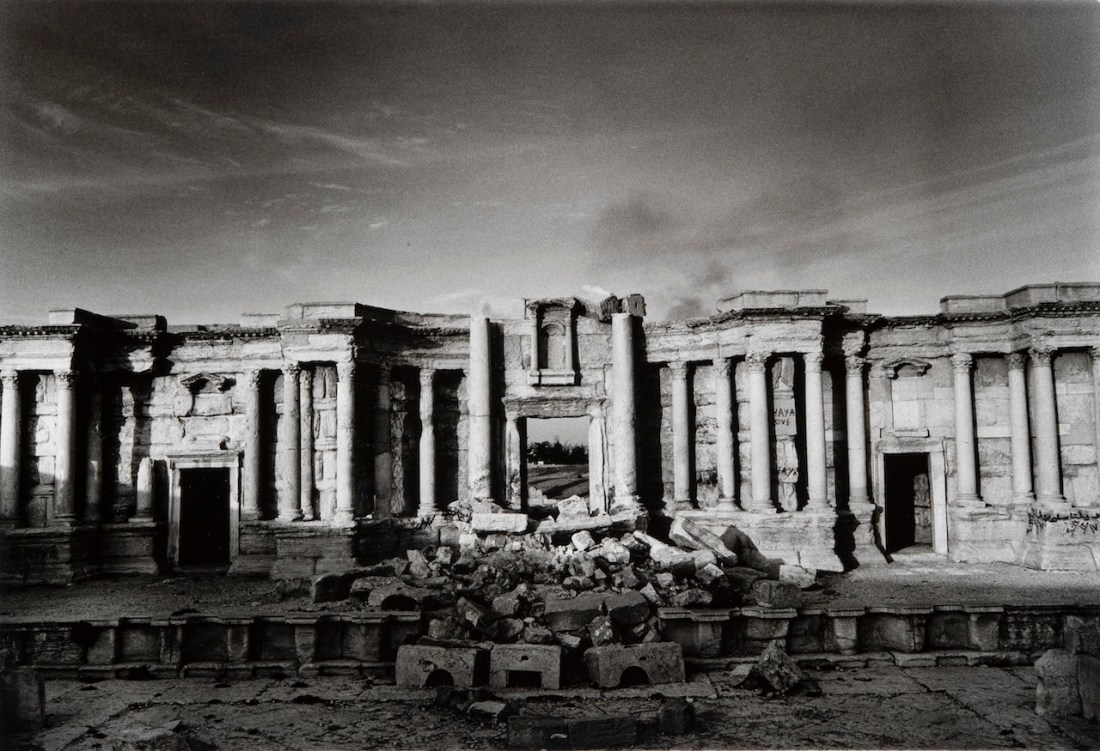
The theatre on the Roman city of Palmyra, partly destroyed by Islamic state fighters 2017 ©Don McCullin
The importance of documenting areas of vast history has been recorded for decades so that younger generations can understand the history whether this has been good or bad and how we can learn from the mistakes made during that timeframe.
During the 2011 uprising IS began to target many sacred ancient locations throughout Syria. Many locations were either destroyed with large amounts of explosives turning them to rubble and unrecognisable. Giant statues, pillars to temples and gateways pulled down and desiccated. Faces from statues removed by hacking them off. Many of these ancient ruins had hundreds of artefacts stolen and sold on the black market to find the IS propaganda regime.
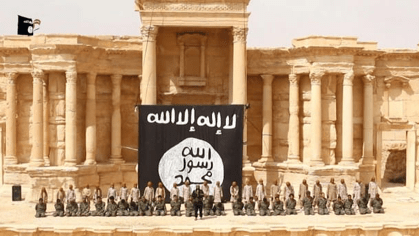
The devastation that McCullin catches through his photographs calls upon the emotions on a personal level. When comparing the two images side by side, it becomes visible from the devastation. Reading further articles and video propaganda footage on articles how IS executed nearly two dozen pro-Assad foreign fighter resisting IS. The theatre became a stage for mass beheadings. Something IS has been able to manipulate propaganda to the media for the world to see where previously this has never been something the world has seen first-hand how elaborate video and media productions together to strengthen the IS Caliphate.
Those colossal roman stone structures from two thousand years ago filled me with awe, then it dawned on me how they were achieved. Through cruelty. Through wickedness and slavery. The staggering accomplishment was a product of brutality. It reminded me of the German camps where people worked until they dropped. This achievement was being stolen from me as I looked at it. I thought I could almost hear the cries as people were crushed under those huge stones. One comes away with mixed experiences, and they’re valid feelings. (Don McCullin, 2019, pp. 163)
McCullin has a way of compositing and capturing the environment in one take, the depth of field created draws the viewer into the image by not just by looking at it but being able to feel the emotions; he felt.
Throughout this course, we have looked at how an image can be manipulated or staged to provide a scripted narrative. Had images like this not been captured showing vast destruction and devastation IS would have been able to capitalise their advantage, promoting an ideology through IS media channels. Distribution of fake news and destroying what true Islam is.
By documenting what atrocities during the conflict in war, the world can see a snapshot of reality. When watching the road Palmyra online, McCullin’s still images hold the viewer in a gaze far better and watching the documentary.
During a documentary, both McCullin and Cruickshank present both the feelings and emotions during the visit. During one-part, Colin takes a picture from the top of a bombed-out building looking out towards a mosque. Surrounding buildings as far as the eye can see are either rubble or fallen down. The mosque is shimmering in the late evening sun just before it starts to set.
To the latter part of the film, McCullin meets two brothers whom the father was taken from them, beheaded, crucified and hang for days for everyone to see and stray animals and vultures to eat the decaying headless body. His head in one place his body in another. Islamic burial is within twenty-four hours; the bodies positioned so that the head is facing towards Mecca. Something the family was not able to do. McCullin’s emotions are visible during this meeting. Witnessing things like this have been part of his career for years. He has seen things where others can only imagine sight or emotion.
Arguably it is just a picture of an ancient Roman ruin. From the bottom of the picture through to the skyline emotions can be felt. Darkness surrounds the stage, an area where something dark has taken place. The main wall behind holds a structure of importance status. It has provided IS with the perfect backdrop for those mass executions.
Conclusion
From personal experiences of combat in arenas where terrorist organisations or waring factors have destroyed areas of land or historical locations that have been vital for the so-called war effort, pulls emotions that at times are hard to explain. Documenting these times in snapshots were able to prosecute them for the actions or war crimes they have committed. Cruickshank makes a point about being able to rebuild the city to its original state, mainly down to people like McCullin that have photographed the city well before IS occupation and destruction. Although it will not be the same, however, the question now, is this worth the rebuild as IS will be no more at some point?
A picture does paint a thousand words in this case. Better to still have great pictures of what it was to have no pictures at all.
Bibliography
Baker, S. (n.d.). Don McCullin (pp. 163–164).
Channel, E. (1970, January 1). The Road To Palmyra – Video Dailymotion. Dailymotion. Retrieved April 30, 2020, from https://www.dailymotion.com/video/x6jaqa4 [accessed 300420]
Dearden, L. (2017, January 19). Isis Execute Teachers In Front Of Children After Retaking The City Of Palmyra. The Independent. Retrieved April 30, 2020, from https://www.independent.co.uk/news/world/middle-east/isis-palmyra-syria-executions-islamic-state-retake-city-russia-assad-ruins-roman-theatre-civilians-a7535026.html [accessed 300420]
Haaretz. (2015, August 19). ISIS Beheads Archaeologist In Ancient Syrian City Of Palmyra. Haaretz.com. Retrieved April 30, 2020, from https://www.haaretz.com/isis-beheads-archaeologist-in-ancient-syrian-city-1.5388578 [accessed 300420]
Photographer, A. (2016, June 7). Don McCullin Interview: Life In Black & White – Amateur Photographer. Amateur Photographer. Retrieved April 30, 2020, from https://www.amateurphotographer.co.uk/technique/interviews/don-mccullin-life-black-white-79500 [accessed 300420]
Schultz, J. (2016, April 2). Palmyra: Before And After ISIS | Pictures | Reuters. U.S. Retrieved April 30, 2020, from https://www.reuters.com/news/picture/palmyra-before-and-after-isis-idUSRTSCQPG [accessed 300420]
Worley, W. (2016, April 2). Full Extent Of Isis Destruction Of Palmyra Revealed In Devastating Before And After Photos. The Independent. Retrieved April 30, 2020, from https://www.independent.co.uk/news/world/middle-east/palmyra-syria-photos-new-palmyra-photos-show-devastation-of-artefacts-ruined-by-isis-a6964766.html [accessed 300420]
(2019, February 11). British Photojournalist’s Career Capturing Conflict Now On Show In London. The National. Retrieved April 30, 2020, from https://www.thenational.ae/arts-culture/art/british-photojournalist-s-career-capturing-conflict-now-on-show-in-london-1.824058 [accessed 300420]
 Part Two Context and Narrative BA HONS in Photography OCA